

Why We Strictly Refuse “Free Sampling”: An Open Letter from Our Factory
Why We Strictly Refuse "Free Sampling": An Open Letter from an Apparel Factory with 20 Years of Export Experience to Independent Brands
Key Takeaways
- A single prototype is a standalone engineering cycle — CAD drafting, small-yardage sourcing, single-ply cutting and one master machinist — not a free add-on to a bulk order.
- “Free samples” hide three structural traps: margin inflation in bulk pricing, a production bait-and-switch, and retention of your CAD cut-files.
- We bill sampling as an independent, non-refundable development service, so bulk quotations stay clean with no hidden surcharge carried over from development.
- Our focus is small-to-medium batch manufacturing held to Japanese and high-end retail tolerances — not volume-driven fast fashion.
Introduction: Addressing the Request, "Can You Make a Free Sample First?"
Operating on the front lines of apparel manufacturing in Dalian, China, for over twenty years has given us a clear view of how global garment supply chains evolve. Over these two decades, our factory has partnered with Japanese trading houses, established global retail labels, and a growing wave of independent designers, startup founders, and boutique apparel brands.
During initial discussions with early-stage brand owners, we frequently encounter inquiries like:
"We are planning a significant bulk production run, but we want to verify your factory's workmanship first. Can you make our prototype for free?"
"If you waive the initial sample development fee, we will send over our tech packs immediately."
Years ago, driven by the eagerness of a young factory seeking new market entry and striving to prove technical competence, we occasionally conceded to such requests. Today, having managed thousands of production styles and navigated stringent international quality standards, DALIAN LAISIPENG CO., LTD maintains an unequivocal, non-negotiable protocol: Under no circumstances do we offer complimentary sample development (first prototypes, fit samples, or design mock-ups).
When we state this policy, prospective clients occasionally interpret it as rigid or unsupportive toward emerging designers.
In reality, the exact opposite is true. This rule does not stem from corporate inflexibility. It is a fundamental commercial principle established through two decades of contract manufacturing, specifically designed to protect serious brand creators, safeguard factory artisans, and maintain a level playing field grounded in operational integrity.
The market is filled with sourcing brokers and cut-make-trim (CMT) workshops advertising "Free Prototyping" or "Zero-Cost Sampling." Yet, experienced brand directors know that shortcuts in development inevitably result in delivery delays, inconsistent fit grading, and poor stitching in mass production.
To bridge this information gap, we are laying bare the real operational mechanics of sample creation—dissecting why an apparel prototype is a standalone engineering phase, and why transparent billing is the only viable path to long-term manufacturing success.
Chapter 1: The Invisible Cost Architecture — One Prototype Equals an Entire Production Cycle
A common misconception among non-technical buyers and first-time fashion entrepreneurs is viewing sample fabrication as a minor, zero-cost precursor to mass manufacturing. The prevailing assumption is that a factory simply gathers scrap fabric, assigns an operator on downtime, and stitches a prototype together within an hour or two.
In true apparel engineering, that assumption is entirely detached from reality.
The manufacturing efficiency of producing 1,000 units on an integrated assembly line operates on a completely different plane than drafting, testing, and constructing a single bespoke prototype from scratch. Measured on an hourly labor-cost basis, the labor and technical overhead required to build a single prototype is dozens of times higher per unit than in bulk manufacturing.
To understand why, examine the actual operational pipeline executed by our technical team for every prototype:
[Design Input & Tech Pack Audit]
               │
               ▼
[Senior CAD Drafting & Pattern Engineering] ──► Shrinkage, balance, ease allowances
               │
               ▼
[Bespoke Material & Trim Procurement]      ──► Color-matching threads, sample yardage
               │
               ▼
[Manual Single-Ply Layup & Shearing]        ──► Grainline alignment, zero tension
               │
               ▼
[Dedicated Sample Machinist Assembly]       ──► Needle gauge, tension balance, pressing
               │
               ▼
[QA Inspection, Tol. Check & Spec Audit]    ──► ± tolerance verification
1. Zero-Base Pattern Engineering and CAD Drafting
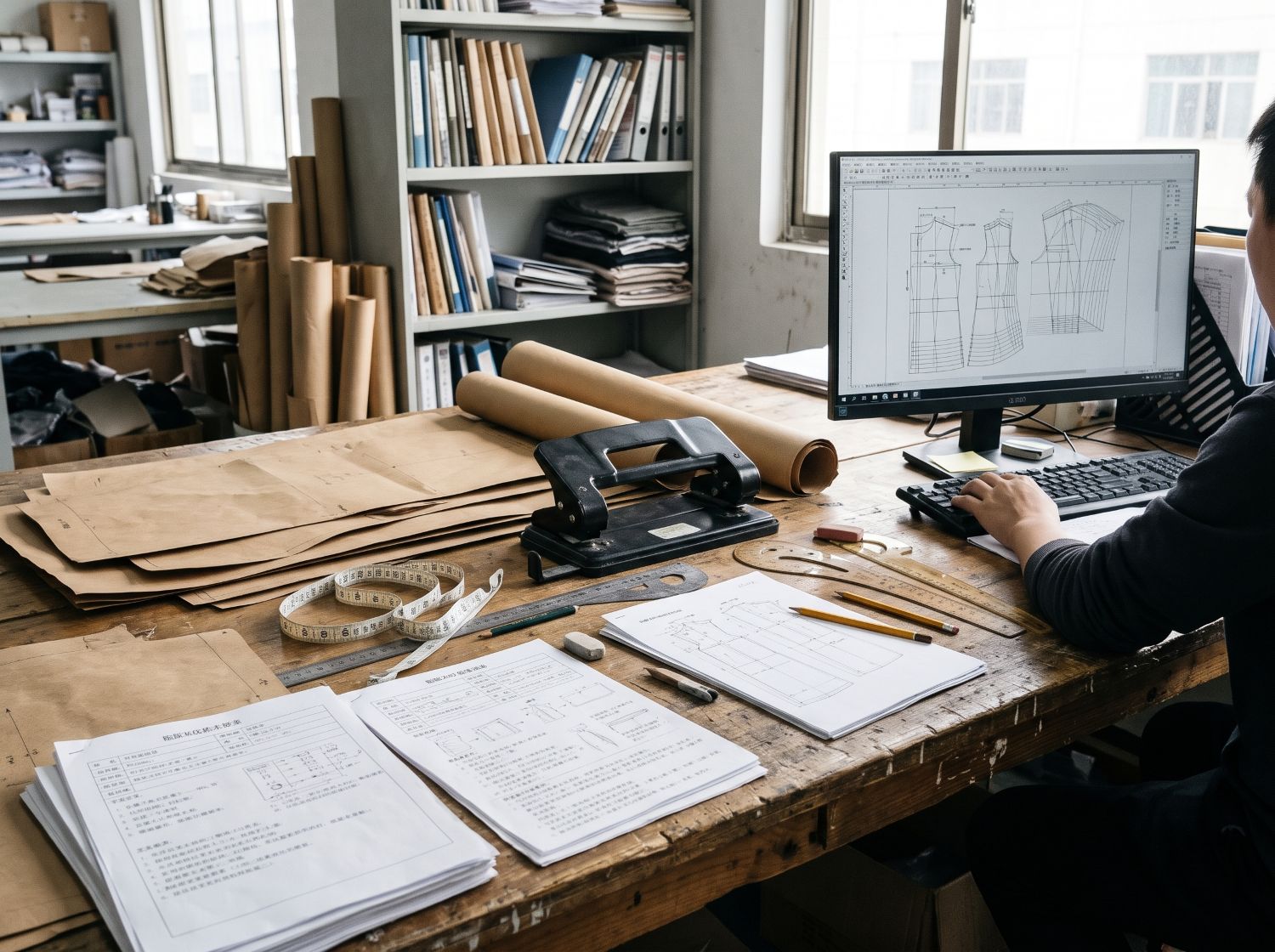
Garment excellence is dictated by silhouette, ergonomic balance, and structural drape—all governed by the master pattern. When an independent designer provides a technical flat sketch, mood board photos, or a preliminary tech pack, our senior CAD pattern makers do not merely hit "print."
- Translating 2D to 3D: Calculating complex armhole contours, neck drops, and shoulder slope pitch to millimeter precision.
- Accounting for Physical Fabric Behavior: Pre-calculating shrinkage rates across warp and weft, elasticity return (kickback) on elastane blends, and differential bias stretching.
- Interfacing and Lining Ratios: Engineering the interlining tolerances so that fusing stabilizes structural collars and lapels without causing puckering.
No CAD software automates these decisions. They require seasoned pattern engineers with fifteen to twenty years of floor experience who can mentally visualize the garment's internal drape before plotting the master cutting pattern. This preliminary step alone commands half a day—and often a full workday—of senior technical labor.
2. Fragmented Sourcing for Small-Yardage Fabrics and Trims
In bulk manufacturing, fabrics are knitted or woven in mill runs spanning thousands of meters, and trims arrive packaged in bulk lots. Prototyping, by contrast, requires mere strike-off sample yardage—often between 1.0 to 2.5 meters.
- Sourcing specialists must comb fabric markets to match the client's hand-feel, yarn count, GSM (grams per square meter), and fiber composition specs.
- Sourcing exact-match sewing threads (polyester spun, core-spun, or filament) requires cross-referencing Pantone codes against specialized dye cards.
- Procuring functional components: sourcing specific YKK sliders, custom teeth finishes, exact fusible non-woven interfacings, and specialized stay-tapes in single-unit quantities.
Textile wholesalers treat one-meter sample cuts as a high-friction chore, routinely levying heavy "sample cutting surcharges." When factoring in logistics, freight charges, and sourcing staff hours, procuring raw materials for a single sample consumes substantial overhead before scissors ever touch cloth.
3. Single-Ply Manual Shearing and Grainline Truing
In bulk lines, multi-tier fabric spreaders stack dozens or hundreds of plies on vacuum tables for automated computer-controlled cutting (CAM) or vertical band-knife slicing, bringing per-unit cutting labor close to zero.
A prototype, however, is cut manually as a single layer.
The fabric must rest flat on a dedicated cutting table to release all residual winding tension. The cutter must verify true grainlines, crossgrains, and bias lines by hand. For pattern-matched styles—such as yarn-dyed plaids, structural stripes, or engineered prints—individual pattern pieces must be laid out, pinned, and sheared one by one using manual shears or handheld rotary blades. Handling fluid silks, lightweight viscose, or high-stretch functional knits requires extreme technical control; a two-millimeter slip will distort the entire fit.
4. Dedicated Master Sample Machinists: Single-Operator Construction
Once cut, the pieces enter the development studio. Crucially, prototypes are never constructed on a distributed assembly line.
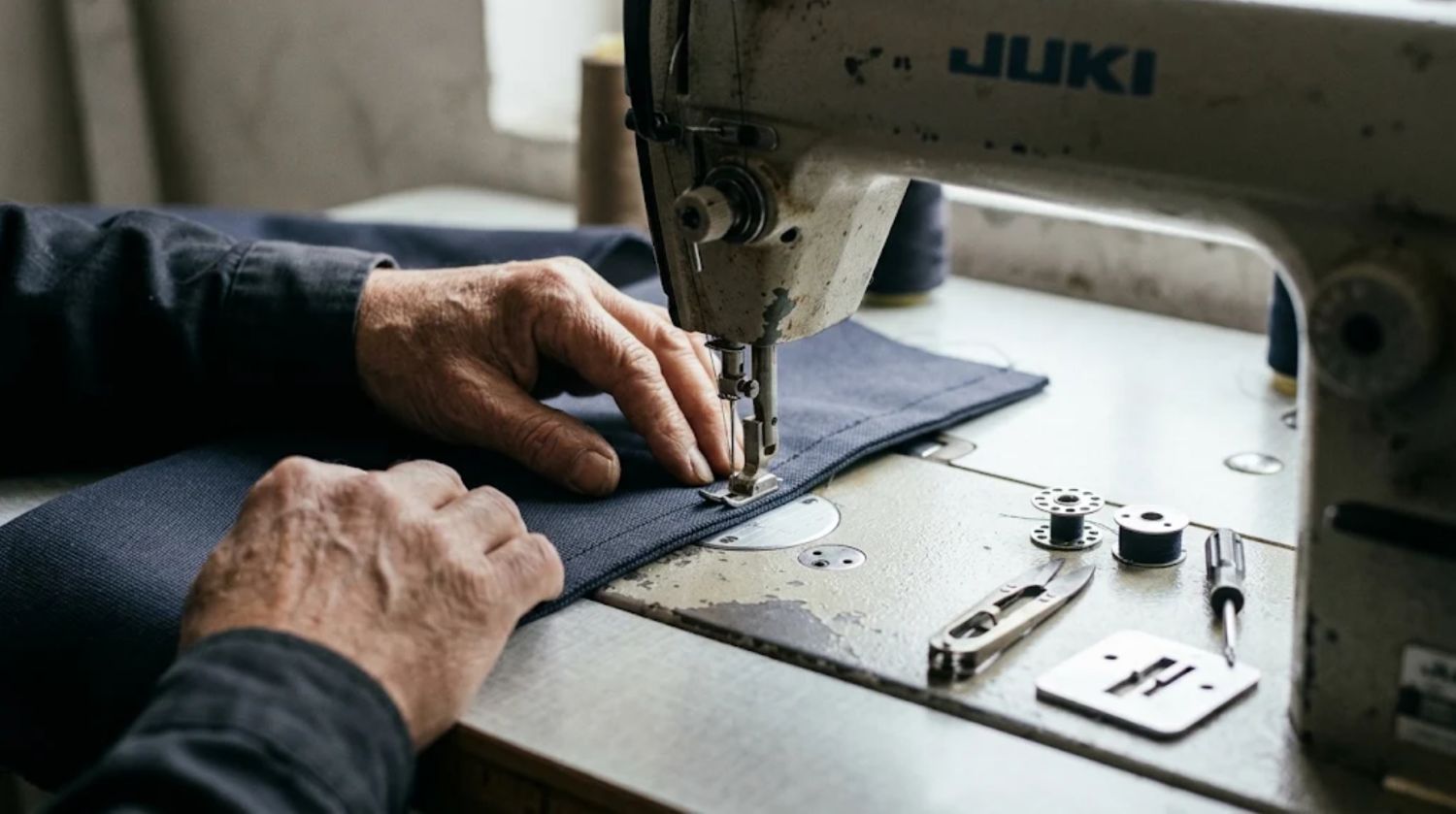
Bulk production relies on an assembly line model: Operator A joins shoulder seams, Operator B inserts sleeves, and Operator C runs hem topstitching. In our sample room, a single master machinist—a craftsman possessing mastery over single-needle lockstitch, 4-thread overlock, coverstitch, and specialized interlock machines—builds the garment from the first seam to final assembly.
- Machinery Calibration: Adjusting needle size (e.g., swapping from universal #11 to ballpoint #9 or heavy-duty #16), fine-tuning feed-dog height, and calibrating upper/lower thread tensions to prevent seam puckering.
- Component Manipulation: Customizing presser feet, edge-guides, and binder attachments to execute targeted hem widths and topstitch allowances.
- Intermediate Ironing & Pressing: Pressing open internal seam allowances (under-pressing) as each sub-assembly progresses, fixing structural curves with commercial steam presses.
Following assembly, the garment moves to buttonholing, bar-tacking, loose-thread trimming, full final pressing (top-pressing), and a point-by-point tech-pack audit across the QA measurement table to confirm tolerance limits.
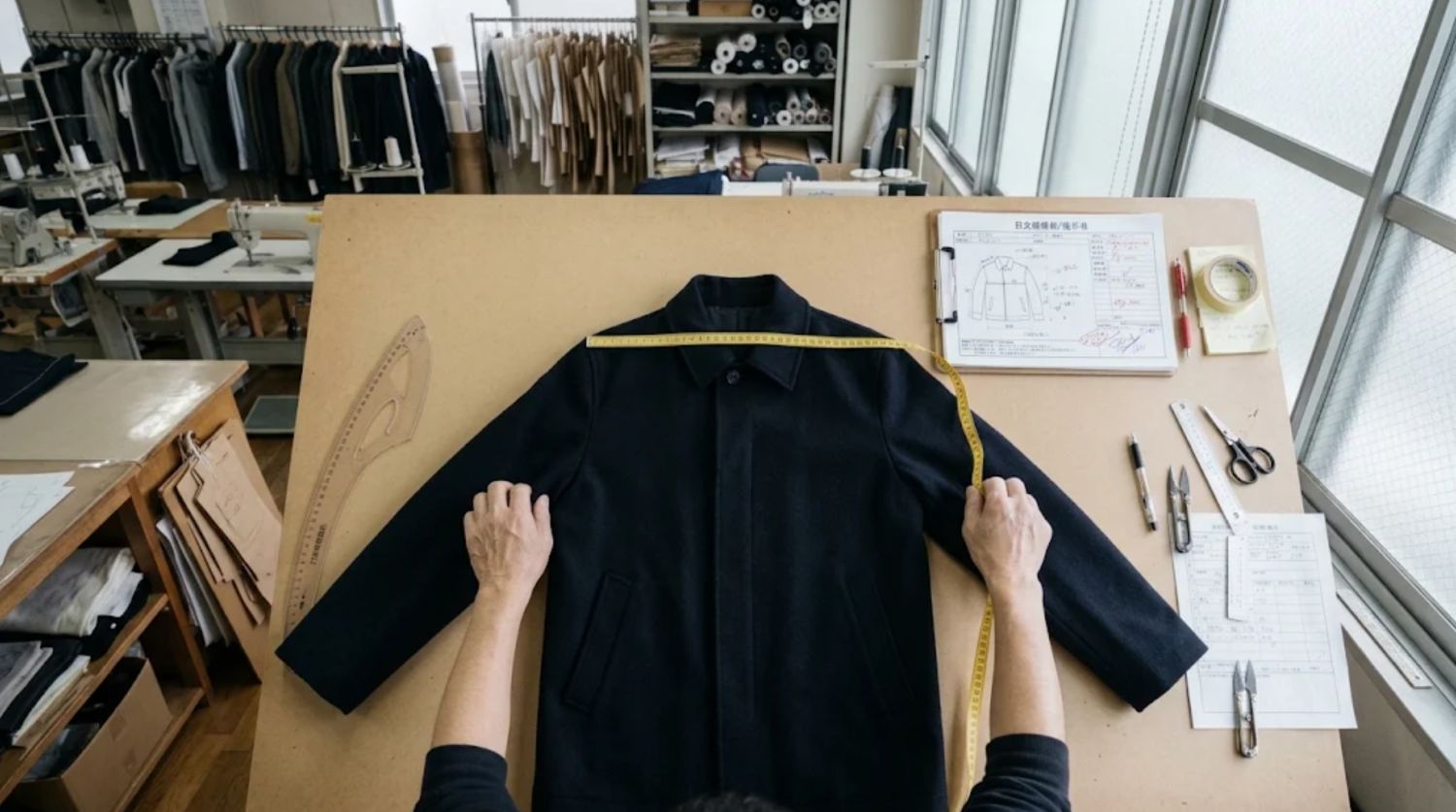
Calculating pattern engineering hours, procurement overhead, specialized machinist wages, machine amortization, and utility overhead, a single well-constructed prototype costs our factory substantial direct financial outlays. Demanding that a factory absorb these operational expenditures under the banner of "free sampling" is, quite frankly, requesting that skilled industrial craftsmen perform skilled labor for free.
Chapter 2: The Structural Trap of "Free Samples" in Apparel Manufacturing
Despite this operational reality, advertisements promoting "Free Prototyping" or "Zero-Cost Samples" remain prevalent online. Independent brands must look past the sales pitch and examine the underlying math.
No commercial enterprise operates as a charitable foundation. If a factory foregoes charging for sample development, it must recoup those incurred development costs somewhere else. Across two decades in apparel manufacturing, we have observed the structural traps that accompany "free sampling":
1. Margin Inflation
Typical “free sample” dynamic: Development losses are hidden within future bulk price-per-piece (FOB/CMT) calculations.
Real operational consequence: The buyer pays an ongoing premium on every mass-produced unit, severely compressing retail gross margins.
2. Production Bait-and-Switch
Typical “free sample” dynamic: Samples are outsourced to high-end boutique studios, or built using cheap scrap fabrics and stock blocks.
Real operational consequence: The sample looks immaculate, but the actual factory production floor lacks the technical skill to replicate the finish, resulting in disastrous bulk quality discrepancies.
3. Intellectual Property Exploitation
Typical “free sample” dynamic: The factory retains proprietary ownership of CAD cut-files and tech packs created "pro bono."
Real operational consequence: If the client does not place a bulk order, pattern files are withheld, or proprietary design concepts are liquidated on cross-border fast-fashion platforms.
A healthy, reliable manufacturing relationship cannot be built on obscured margins or subsidized services. The soundest business framework is one where development and production are cleanly separated and transparently billed on their own merits.
Chapter 3: Why We Treat Sampling Fees as Independent, Non-Refundable Development Costs
In the apparel OEM sector, a common compromise is the rebate model: "Pay for the prototype upfront, and the sample fee will be deducted/refunded from the invoice when bulk production is confirmed."
While that structure is an improvement over unpaid development, DALIAN LAISIPENG operates on a stricter, cleaner framework: We bill sample development as an independent, professional service, and we do not credit or refund sample fees against bulk production.
This is not a display of corporate rigidity. It is a deliberate, mathematically honest operating philosophy that directly protects our clients' operational interests:
1. Prototyping is Technical Research & Development (R&D), Not a "Bulk Prepayment"
A prototype is not a down payment on mass units; it is a structural validation study.
The sample room operates as our engineering and design verification laboratory. Its function is to test the viability of the client’s creative vision:
- Verifying if the selected fabric weight achieves the intended structural drape.
- Resolving seam puckering, neckline tension, or stress-point vulnerabilities through iterative grading adjustments.
- Troubleshooting production bottlenecks, identifying tooling requirements, and establishing manufacturing SOPs for the assembly line.
When the completed sample arrives at the designer's studio, 100% of the technical service has been delivered and consumed. The client receives a tangible physical prototype, an optimized cut-and-sewn pattern, and documented manufacturing specifications. It is a completed deliverable of professional technical consulting and craftsmanship, and it warrants clean commercial closure.
2. Clean Billing Eliminates Inflated Bulk Production Quotations
Refunding development expenses out of mass manufacturing runs creates financial distortion. When a supplier promises to rebate sampling fees, the factory must calculate a margin buffer within the bulk CMT (Cut-Make-Trim) unit costs to absorb that past development loss.
We refuse this financial sleight of hand.
By keeping development fees entirely independent, DALIAN LAISIPENG quotes bulk production with absolute fiscal clarity:
- Development Phase: Fair compensation for CAD engineers, fabric sourcing teams, and sample machinists.
- Bulk Manufacturing Phase: Honest, razor-sharp unit pricing calculated purely on true yardage usage, direct trim invoices, assembly-line cycle times, and rigorous finishing inspections.
Our clients do not carry hidden surcharges for past prototypes on their production orders. This enables accurate budgeting, reliable costing models, and sustainable brand unit economics.
3. Professional Risk Parity Between Brand and Maker
Launching a new collection inherently carries calculated commercial risk. Designers invest their capital, vision, and marketing capacity. Concurrently, factory technicians dedicate their specialized skills, time, and shop-floor capacity.
Paying an independent, non-refundable development fee is an upfront validation of brand intent. It confirms that the label approaches its collection as a serious enterprise deserving of professional technical development.
If a prototype reveals that a specific fabric is structurally incompatible with a design, or if a founder shifts creative strategy and shelves a style, both parties walk away on balanced footing. The factory has been fairly compensated for its specialized engineering hours, and the brand has secured valuable product validation data without incurring manufacturing liabilities.
Neither side carries commercial resentment. That professional balance is the reason our core brand clients return season after season.
Chapter 4: The DALIAN LAISIPENG Standard — Reserving Craftsmanship for Dedicated Partners
DALIAN LAISIPENG is not a fast-fashion, multi-million-unit mass supplier prioritizing volume over execution. Our operational advantage is focused: We provide small-to-medium batch apparel manufacturing with the precise stitching tolerances, structural longevity, and finishing standards demanded by the Japanese and high-end international markets.
┌─────────────────────────────────────────────────────────────┐
│                 DALIAN LAISIPENG STANDARDS                  │
├──────────────────────────────┬──────────────────────────────┤
│ • Small-to-Medium Batch Flex │ • Dedicated CAD Pattern Room │
│ • Japanese QA & AQL 2.5/4.0  │ • High-Density Stitch (SPI)  │
│ • Precise Pattern Matching   │ • Complete Fiscal Cleanliness│
└──────────────────────────────┴──────────────────────────────┘
The industrial legacy of Dalian as an export apparel hub was built on decades of exacting oversight from Japanese technical directors and premier trading houses. That legacy lives in our shop floor:
- Strict stitch-per-inch (SPI) densities across woven and knitted seams.
- Rigorous pattern alignment along front plackets, yoke junctions, and side seams.
- Controlled interior seam bindings, clean clean-finish overlocking, and pressing standards that mirror bespoke tailoring.
Yet, a specialized pattern maker’s hours and an expert machinist’s throughput are finite assets. A factory cannot expand technical development bandwidth infinitely without sacrificing execution quality.
If we were to squander our technical capacity processing speculative, unpaid sample requests from uncommitted parties, our dedicated, long-term brand partners would pay the price through slower communication, delayed development cycles, and strained floor supervision.
We prioritize our technical resources for partners who share our dedication to product integrity:
- Independent designers and creative directors who obsess over structural cut, proportion, and fabrication.
- Label founders who respect the operational realities of the supply chain and value mutual, equitable partnerships.
- Brands designing garments built to last in consumer wardrobes rather than wind up in landfills after three washes.
When we receive an intricate tech pack or an inspiring silhouette concept, we hold deep respect for the creative investment it represents. In turn, we ask that our brand partners respect the twenty years of trade expertise, technical problem-solving, and sweat equity invested by our pattern makers and workshop craftsmen.
Conclusion: Building Together on Ground Truth
Apparel manufacturing is not a software-based transaction completed at the click of a mouse. It is an intricate, physical craft operating at the intersection of organic textiles, heavy mechanical apparatus, and high human skill.
If you are seeking a production partner that will:
- Engender honest, peer-to-peer technical dialogues regarding pattern geometry and seam construction,
- Deliver the rigorous finishing and dimensional precision demanded by high-tier international retailers, and
- Provide transparent manufacturing costs devoid of hidden surcharges or disguised fees,
we invite you to build with DALIAN LAISIPENG.
We will not compromise on our engineering standards by dangling the lure of "free samples." Instead, we promise that every dollar you commit to technical development will be matched with skilled craftsmanship, meticulous oversight, and an unwavering commitment to bringing your garments to life exactly as intended.
