

50-Piece MOQ Apparel Quote Guide | DALIAN LAISIPENG
Introduction | "Will There Be Extra Charges Later?" — The #1 Question Buyers Ask
"Aside from this quote, are there any extra charges or surprise fees later on?"
Almost every time an independent brand founder, designer, or sourcing manager reaches out to us, this is the very first question they ask. For emerging D2C labels working with an overseas factory, the biggest concern isn't just the unit price—it is whether that quoted number is truly final, or merely a bait-and-switch entry ticket.
Here is our direct answer: At Dalian Laisipeng, once we issue a formal quotation, we do not add surprise fees or post-quote surcharges unless you request changes to your specifications.
Why do some factories quote an unrealistically low price upfront—only to hit you later with pattern fees, fabric wastage surcharges, inspection add-ons, or packaging charges—while others honor a clean, locked-in FOB unit price from day one through shipment?
The difference comes down to how thoroughly the factory calculates its internal bill of materials and labor minutes before sending you a number.
A standard export quotation shows a single FOB unit price per garment (in USD or RMB). Naturally, a factory's raw fabric supplier rates and internal line-minute costs are proprietary business data, so manufacturers do not hand over their internal accounting sheets. However, a disciplined export factory builds every single variable—from fabric wastage and thread matching to 100% needle detection and export-grade cartons—into that single quoted figure upfront. Because we calculate every step accurately behind the scenes, we give you one straightforward, reliable unit price with zero surprises down the road.
Drawing on two decades of export apparel manufacturing in Dalian, China, this guide explains how a full-package FOB quote is constructed, how our 50-piece small-batch workflow operates, and the exact conditions under which a quote can ever change.
What Makes Up Your Unit Price — The 7 Internal Cost Buckets
To evaluate a full-package clothing manufacturer's quote properly, you need to verify what materials, labor, and quality controls are covered inside that unit price. At our facility in Dalian, China, every FOB quote is engineered internally across seven distinct cost buckets:
| # | Cost bucket | What it covers | Typical share of unit cost | Key cost drivers |
|---|---|---|---|---|
| 1 | Fabric | Shell fabric, lining, interlining (includes 3–8% cutting wastage) | ~30–40% | Fabric MOQ, dye-lot minimums, performance finishes |
| 2 | Trims & hardware | Thread, buttons, zippers, elastic, woven labels, hangtags | ~8–15% | Branded hardware (e.g., YKK), custom engraved molds |
| 3 | Special processes | Screen/digital printing, embroidery, garment washing/dyeing | ~0–15% | Number of screens/colors, wash complexity, peak season |
| 4 | CAD pattern & grading | Digital master pattern drafting & multi-size grading (XS–XL) | $0 (Free on bulk orders) | Typically $150–$400+ per style elsewhere |
| 5 | Cut & sew labor | Total sewing operations × Standard Allowed Minutes (SAM) × line rate | ~25–35% | Construction complexity, delicate or stretchy fabrics |
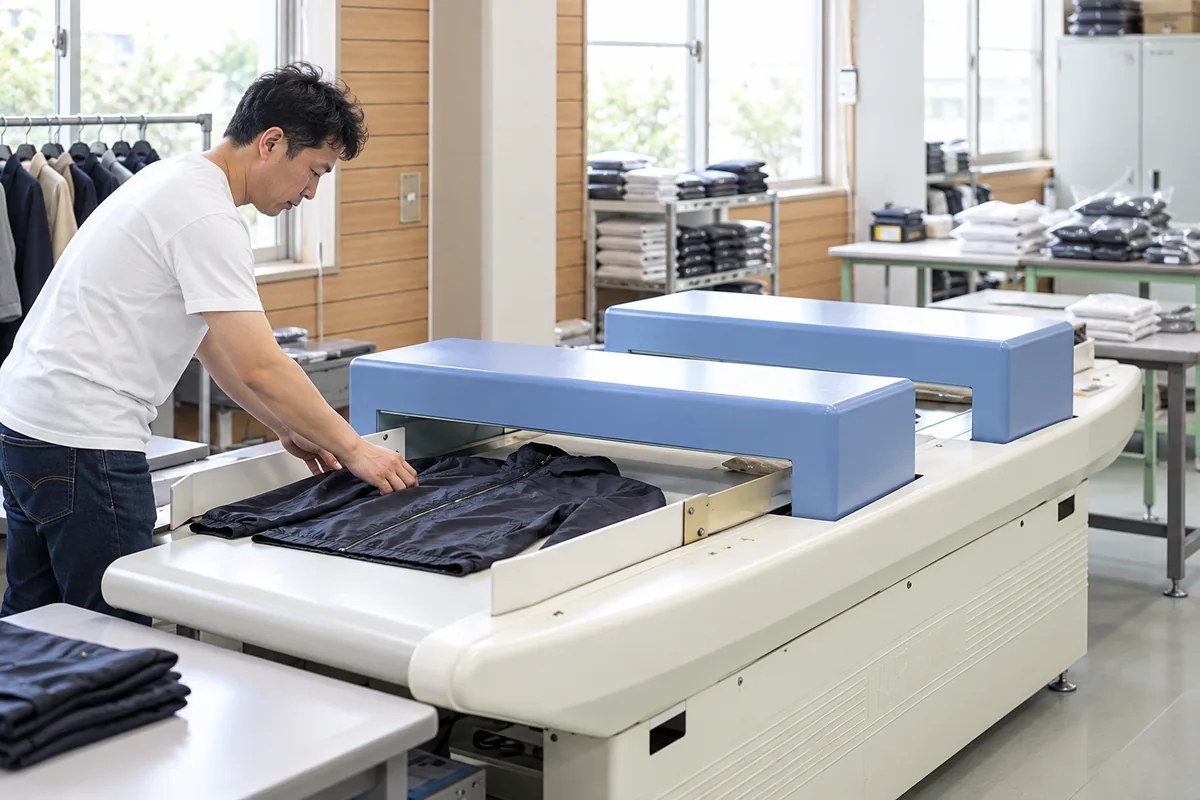
| 6 | Needle detection & QC | 100% metal detection + inline and final garment inspection | ~3–6% | Full-lot inspection vs. random sampling |
| 7 | Packaging & labeling | Polybags, care/content labels, size stickers, export cartons | ~3–5% | Multi-language care labels, custom branded packaging |
Note: Percentage ranges above reflect typical industry benchmarks; actual allocations vary by garment category and always sum to 100% of your quoted unit cost.
When Dalian Laisipeng quotes you an FOB Dalian unit price, all seven buckets above are already included (international freight, import duties, and destination VAT/taxes are excluded).
Please note: Digital CAD pattern drafting and size grading are completely free ($0) when you place a bulk production order. For standalone pre-production sampling rates, please see the FAQ section below.
1. Fabric (Shell, Lining, Interlining & Cutting Wastage)
Fabric typically accounts for the largest share of any garment's cost. Inexperienced suppliers often quote based on theoretical net fabric consumption, ignoring real-world cutting room realities. Fabric rolls can have edge defects, plaid or stripe matching requires extra yardage, and marker nesting leaves unavoidable offcuts. We factor a realistic 3–8% wastage allowance directly into your initial quote so you never receive a mid-production invoice claiming "we ran short on fabric."
2. Trims & Hardware (Threads, Zippers, Buttons & Labels)
This covers color-matched sewing threads, buttons, snaps, waistbands, drawcords, woven brand labels, and size tabs. If your design specifies branded hardware like YKK zippers or custom-molded metal buttons, we verify the trim supplier's minimum order quantity (MOQ) and unit pricing before quoting, locking those numbers into your FOB price upfront.
3. Special Processes (Printing, Embroidery & Garment Washes)
Subcontracted specialty work—such as silk-screen printing, DTG/digital prints, high-density embroidery, enzyme washes, or vintage garment dyeing—is priced and confirmed prior to quoting. Screen setup charges or wash-house minimums are factored into the quote from the beginning rather than tacked on as surprise invoices later.
4. CAD Pattern Drafting & Grading (Free on Bulk Orders)
Translating your tech pack, sketches, or reference garments into production-ready digital patterns and grading them across sizes (e.g., XS–XL) requires experienced pattern engineers. Many factories or sourcing agents bill $150 to $400+ per style for this service. At Dalian Laisipeng, our in-house CAD pattern team handles pattern creation and grading at $0 cost when you proceed with bulk production.
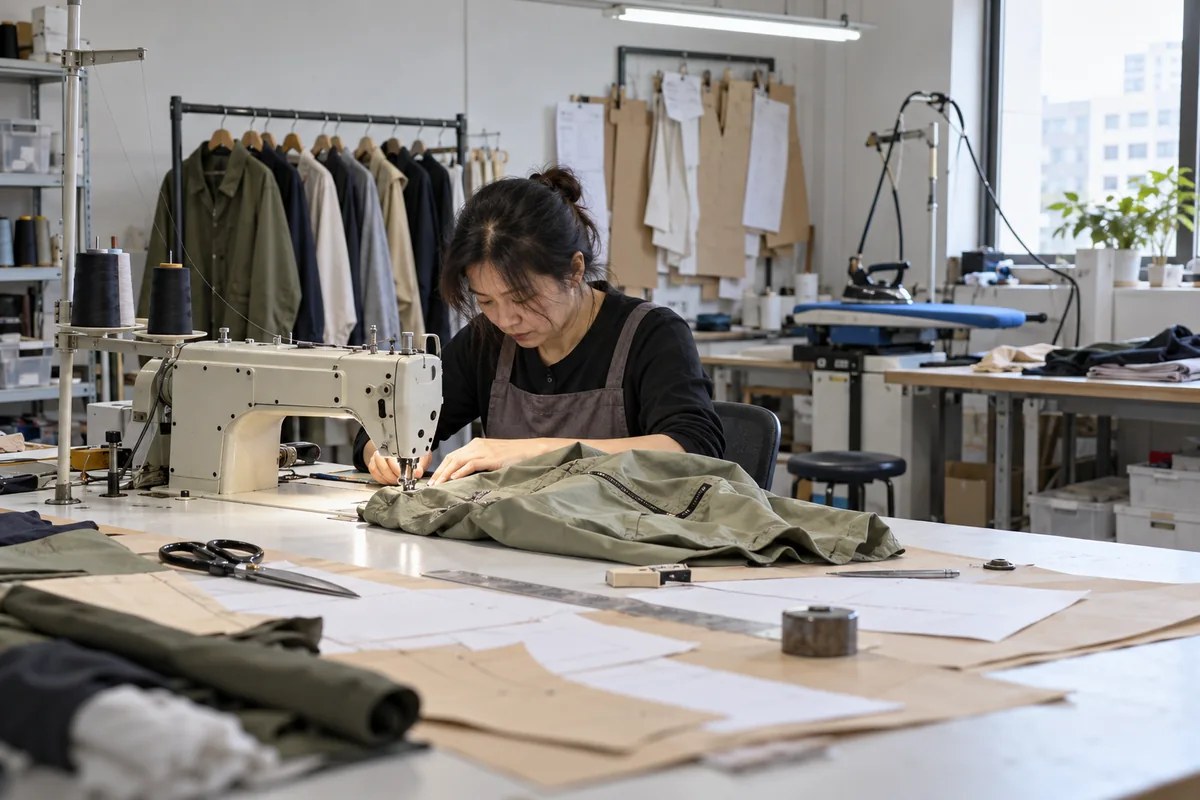
5. Cut & Sew Labor (SAM & Operation Breakdown)
Sewing labor is never guessed—it is engineered using Standard Allowed Minutes (SAM) across every individual sewing operation. A basic crew-neck tee takes a fraction of the line minutes required for a lined trench coat with welt pockets, storm flaps, and topstitching. The clearer your tech pack is upfront, the more exact our labor calculation will be.
6. Needle Detection & 100% Quality Inspection
Broken needle fragments or stray metal hardware in finished garments are critical safety hazards for any retail brand. Full-lot needle detection and multi-point measurement/visual inspection are built directly into our standard FOB unit price—never treated as optional extras.
7. Export Packaging & Compliance Labeling
Your quote includes sewn-in fiber content and care labels, hangtag attachment, individual polybags, and heavy-duty double-wall export cartons engineered to withstand ocean humidity and container stacking.
How Our 50-Piece MOQ Works (And Why Unit Prices Scale With Volume)
Many independent brands launch with 50 pieces per style to test market demand without tying up cash in unsold inventory. To keep quotes transparent and avoid any misunderstanding upfront, here is how our 50-piece minimum order works in practice:
- 50 pieces per style, single colorway (across sizes): Your 50 pieces can be split across your core size run (for example, XS–XL), provided they share the same fabric and colorway. Splitting 50 pieces into five different colors (10 pieces per color) triggers five separate fabric dye-lot minimums and five machine thread changeovers, which makes small-batch economics unworkable.
- How we run 50-piece orders without cutting corners: Mega-factories built for 10,000-piece runs lose money on small orders because their assembly lines are too rigid. We operate dedicated flexible small-batch lines staffed by multi-skilled sample and boutique operators. You pay a fair small-batch unit price that covers real cutting and changeover time—and in return, you get the exact same fabric quality and inspection rigor as a 5,000-piece run.
To show how volume affects unit economics, here is an indexed comparison using 500 pieces as the baseline (Index = 100):
| Order quantity | Fabric cost index | Sewing labor index | Total unit price index (est.) |
|---|---|---|---|
| 50 pcs (1 colorway) | ~140–160 | ~150–180 | ~145–170 |
| 100 pcs | ~120–135 | ~125–145 | ~125–140 |
| 300 pcs | ~105–110 | ~105–115 | ~105–112 |
| 500 pcs | 100 | 100 | 100 |
Launching at 50 pieces to validate sell-through, then scaling reorders to 300 or 500 pieces to bring your unit index down toward 100, is the healthiest way to protect cash flow and expand gross margins.
Why Japanese Department-Store QC Standards Set Us Apart
Most factories competing for small-batch orders sound identical on paper. What sets Dalian Laisipeng apart is where our manufacturing DNA comes from.
We have spent two decades meeting strict Japanese department-store and specialty-boutique inspection standards. In the Japanese apparel market, a single loose thread, a 3mm measurement deviation, an untrimmed seam allowance, or an unverified shrinkage rate can result in an entire shipment being rejected at the port.
Over twenty years of producing for discerning Japanese buyers, those rigorous controls became our factory baseline—not an "upgrade" you have to pay extra for:
- Full-lot needle detection, 100% piece-by-piece measurement inspection, and pre-production fabric shrinkage testing are our default workflow, built directly into every quote.
- That is why a 50-piece run from our floor delivers the consistency and finish of a 500-piece flagship run elsewhere. For independent Western brands competing on product quality and repeat customer loyalty, Japanese-standard QC eliminates the biggest risk of overseas sourcing.
Why We Do Not Engage in Aggressive Price Haggling
Occasionally, after receiving a quote, a buyer will ask: "Another supplier quoted 20% less—can you match their price?" At Dalian Laisipeng, we do not engage in race-to-the-bottom price haggling that compromises materials or workmanship.
Our initial FOB quote is not padded with artificial "negotiation room." It reflects the real cost of vetted fabrics, proper shrinkage allowances, fair wages for skilled operators, and 100% needle detection and inspection.
When a factory agrees to slash its price by 20% overnight, that money has to come from somewhere: downgrading fabric weight, skipping pre-shrinking, subcontracting to unvetted workshops, or cutting final inspection. Those shortcuts inevitably show up as twisted seams, missed delivery dates, and high customer return rates—costing your brand far more than a few dollars saved per unit.
Lead Times, Payment Terms & Post-Factory Landed Costs
To plan your product launch and cash flow accurately, you need clarity on production timelines, payment milestones, and what happens after your goods leave our factory gate.
Standard Lead Times & Payment Terms
- Pre-production sample lead time: Approximately 2 weeks from tech pack and fabric confirmation.
- Bulk production lead time: Approximately 2–4 weeks after pre-production sample approval and deposit receipt (depending on fabric availability and order complexity).
- Standard payment terms: 30% deposit upon bulk order confirmation, with the 70% balance due prior to shipment (or against copy of Bill of Lading, subject to agreed terms).
Freight, Tariffs & Destination Landed Cost
Our standard quotation term is FOB Dalian (Free On Board), meaning our price covers all production, packing, and local port charges up until your goods are loaded onto the vessel or aircraft in Dalian, China. To calculate your true Landed Cost at your warehouse in the UK, US, or Europe, budget for the post-factory expenses below:
| Cost item | Typical benchmark | Key notes |
|---|---|---|
| Ocean freight (Dalian → UK / US / EU) | ~$1.50–$3.50/kg (or per CBM) | ~30–40 days transit. Bulky items (puffers, hoodies) are billed by Volumetric Weight (L×W×H cm ÷ 6000) |
| Air freight / express courier | ~$6.00–$11.00/kg (chargeable weight) | ~3–6 days door-to-door. Billed on actual vs. volumetric weight (whichever is greater) |
| Customs brokerage fee | ~$75–$200 per shipment | Billed directly by your appointed customs broker / freight forwarder |
| Import duty (apparel) | UK/EU: ~8–12% / US: base rate 12–32% (plus Section 301 surcharges where applicable) | Determined by exact HS Code (knit vs. woven, fiber content). Confirm against official customs tariff schedules |
| Import VAT / sales tax | 20% (UK) / 19–21% (EU) | Calculated on CIF value + import duty (generally recoverable for VAT-registered businesses) |
| Destination drayage & delivery | ~$150–$450+ per shipment | Depends on port distance, carton count, and warehouse delivery requirements |
Disclaimer: Freight rates and tariff rules reflect general benchmarks as of November 2026 and fluctuate with carrier capacity and customs rulings. Please verify exact duty rates against your product's specific HTS/HS code with your licensed customs broker. Note that following the 2026 suspension of the US $800 de minimis exemption, even small commercial apparel shipments entering the United States require formal customs entry and duty payment.
5 Often-Overlooked Compliance & Logistics Details for Western Buyers
First-time importers frequently focus exclusively on factory FOB prices and get caught off guard by destination regulatory requirements. Checking these five items early prevents costly port holds and delays:
| # | Cost / requirement | Purpose | When required | Who pays |
|---|---|---|---|---|
| 1 | Needle detection (metal check) | Prevents broken needles or sharp metal contamination | 100% of every lot (standard) | Included in our FOB unit price |
| 2 | Lab compliance testing | Colorfastness, shrinkage, AZO dyes, CPSIA / REACH | First bulk run or new fabric bases | Paid at cost to 3rd-party labs (SGS, Intertek, BV) |
| 3 | Care & fiber content labels | Legal compliance (UK Textile Products Regs, EU Reg. 1007/2011, US FTC rules) | Every bulk order | Included in FOB trim cost (artwork supplied by buyer) |
| 4 | Childrenswear safety rules | Strict lead, phthalate & drawstring rules (US CPSIA / EN 14682) | Kids & baby apparel only | Lab test fees + specialized trim compliance |
| 5 | Volumetric freight & DDP vs. FOB | Avoiding freight shock on bulky garments | Quote & shipping planning stage | Quoted separately if DDP door-to-door is requested |
1. 100% Needle Detection & Inspection Reports
Every garment produced at Dalian Laisipeng undergoes full-lot needle detection as part of our standard production workflow—already built into your FOB quote. If your retail stockists or third-party warehouses require formal needle detection logs or custom inspection reports, we can provide them upon request. For styles featuring metal zippers, snaps, or rivets, we either source non-ferrous detector-compatible hardware or route those garments through strict manual piece-by-piece inspection protocols.
2. Third-Party Lab Testing (SGS, Intertek, Bureau Veritas)
Depending on your sales channels and fabric finishes, you may need lab verification for wash shrinkage, crocking/colorfastness, or chemical compliance (such as EU REACH or AZO-free dye testing). Third-party lab testing is billed at actual lab cost; we coordinate sample submission directly with accredited testing facilities whenever required.
3. Regulatory Care & Fiber Content Labels
The UK Textile Products (Labelling and Fibre Composition) Regulations, Regulation (EU) No 1007/2011, and US FTC labeling rules each mandate accurate fiber composition percentages, country of origin ("Made in China"), care instructions, and registered business details. While the physical woven or printed labels are included in your FOB quote, finalizing label artwork late is one of the #1 causes of production delays—often pushing shipments back by 1–2 weeks while labels are reprinted. Always lock in label artwork alongside sample approval.
4. Childrenswear & Strict Chemical/Mechanical Standards
Kidswear and infant apparel face stringent legal rules regarding formaldehyde, heavy metals, small-part pull tests, and hood/waist drawstrings (such as US CPSIA and European EN 14682). If you are developing youth or baby garments, let us know at the inquiry stage so we source certified trims and arrange mandatory lab testing upfront.
5. Volumetric Weight & FOB vs. DDP Clarity
Heavyweight hoodies, fleece, and down outerwear take up substantial carton space relative to their scale weight. Both air couriers and LCL ocean consolidators bill based on chargeable weight (comparing actual weight against volumetric weight). Always request estimated carton dimensions and weights before shipment, or ask us for a separate DDP (Delivered Duty Paid) estimate if you prefer a single door-to-door landed figure.
The Only 4 Conditions Under Which a Quote Changes
Because our quotes are built from a complete 7-bucket internal calculation, we never issue surprise post-quote price increases.
The only four situations where a quoted price will ever be revised are listed below—and in every single case, we discuss and confirm any adjustment with you in writing before cutting fabric:
| # | Trigger condition | How Dalian Laisipeng handles it |
|---|---|---|
| 1 | Buyer specification changes (design, fabric, colorways, quantity, or delivery schedule) | We recalculate the exact delta and confirm in writing before proceeding |
| 2 | Quote validity expiration (30 days) | Fabric mill prices and FX rates are re-verified after 30 days |
| 3 | Discontinued or out-of-stock market fabric | We present vetted alternatives with transparent price differences for approval |
| 4 | Tech pack vs. actual construction discrepancy | Flagged before bulk cutting—never sprung on you mid-production |
For example, if you decide after reviewing your prototype to add zippered welt pockets, switch to a heavier 480gsm French terry, or reduce an order from 100 pieces to 50 pieces, we will recalculate the exact material and labor difference and send a revised written quote for your sign-off.
Similarly, because raw cotton, synthetic yarns, and currency exchange rates fluctuate, our quotes remain valid for 30 calendar days. Most importantly, if our pattern engineers discover during pre-production sampling that a detail in your tech pack requires specialized machinery not visible in the initial sketch, we will notify you in writing before a single yard of bulk fabric is cut. Once bulk cutting begins, your price is 100% locked.
Frequently Asked Questions (FAQ)
Q. How much do pre-production samples cost?
A. Sampling is charged at 2× the bulk unit price (your formal quoted price) (covering sample yardage, matched trims, and dedicated master-tailor assembly). Each sample is individually patterned, cut and sewn on its own, so the real cost behind one piece is typically 5–10× the production unit price. To keep your development costs down, we charge 2× the bulk unit price as our standard rate. Example: an outerwear style quoted at $80 → $160 per sample plus shipping. We provide an exact sampling quote once we review your tech pack or reference photos.
Q. Are sample fees refunded or credited toward bulk production?
A. No, sample fees are non-refundable and are not deducted from bulk production invoices. Because each prototype is individually patterned, hand-cut, and sewn from start to finish by a dedicated sample machinist, real material and labor costs are incurred on every piece. However, when you proceed with a bulk production order, we waive 100% of your CAD pattern drafting and size grading fees ($0 charge)—a service that typically costs several hundred dollars per style. Any revision charges resulting from major post-sample design changes are also communicated clearly in advance.
Q. Does your FOB price include import duties and destination VAT/taxes?
A. No. Our standard FOB Dalian quote covers all manufacturing, 100% needle detection, export packing, and local port loading in Dalian, China. Destination import duties, VAT/sales taxes, customs brokerage, and final-mile delivery are paid upon arrival in your country. If you need a door-to-door DDP or DDU quote delivered straight to your warehouse, we can provide a separate logistics estimate upon request.
Why Brands Partner With Dalian Laisipeng (Key Takeaways)
- Established Export Manufacturer in Dalian, China (Two decades of strict Japanese department-store & international export experience)
- Low Minimums Starting at 50 Pieces per Style (Single colorway across your core size run, produced on dedicated flexible lines)
- Fast, Predictable Lead Times (Samples in ~2 weeks; bulk production in ~2–4 weeks after sample approval)
- Free CAD Pattern Drafting & Grading on all bulk production orders
- Locked-In FOB Pricing built on all 7 cost buckets—30-day quote validity, zero surprise charges after cutting
- 100% Lot Needle Detection & Quality Inspection included as a standard process inside your FOB price
Request a Transparent FOB Quote Within 48 Hours
Send us your tech pack, design sketches, or reference photos along with your target order quantities. Within 48 hours, our engineering team will review your specs and return a clear, locked-in FOB quotation with zero hidden fees.
→ Get Your Quote & Production Consultation (/contact_en)
Related Guides
- Starting Apparel OEM at 50 Pieces per Style: Benefits & Process
- Why Smart Fashion Brands Choose Low-MOQ Manufacturing
- Sample Development: How a Chinese OEM Factory Gets It Right
- The Illusion of "Scale": Why Low-MOQ Manufacturing Wins
- Bridging Craftsmanship and Flexibility: Why Emerging Brands Choose Us
Note: Trade, freight, and tariff benchmarks in this guide are current as of November 2026 and are subject to carrier and regulatory fluctuations.
